In 2025, the American Heart Association (AHA) updated its CPR guidelines and changed the recommended hand placement for infant chest compressions.
These updates aim to improve the effectiveness of CPR by helping rescuers deliver deeper and more consistent chest compressions.
Below is a quick overview of the updated techniques.
The Traditional Two-Finger Technique (Now Deprecated)
For many years, infant CPR was commonly taught using the two-finger compression technique.
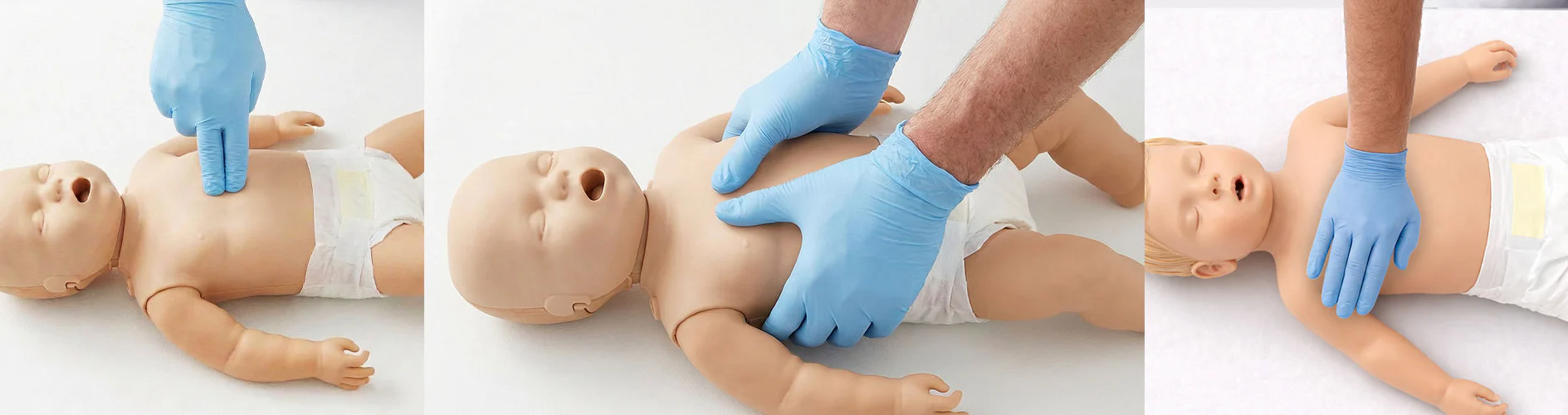
With this method, the rescuer places the index and middle finger on the center of the infant’s chest and performs chest compressions.
However, research has shown that this technique often fails to achieve adequate compression depth, which can reduce the effectiveness of CPR.
Because of this, the two-finger technique has been deprecated in the updated guidelines.
The Preferred Technique: Two-Thumb Encircling Method
The two-thumb encircling technique is now the preferred method for infant CPR.
With this technique:
• Both thumbs are placed on the center of the infant’s chest.
• The hands encircle the infant’s torso, supporting the back.
• Chest compressions are delivered using the thumbs pressing down on the sternum.
This position allows rescuers to generate stronger and more consistent compressions, which helps improve blood circulation during CPR.
CPR for Toddlers and Older Children
As children grow, CPR technique changes.
For toddlers and older children, chest compressions are typically performed using the heel of one hand placed on the center of the chest.
Because their chest is larger and stronger than an infant’s, using the heel of the hand allows rescuers to deliver effective compressions while maintaining control.
Why Staying Updated Matters
CPR guidelines evolve as new research becomes available. These updates help ensure that rescuers are using the most effective techniques possible during an emergency.
Taking the time to learn or refresh your CPR knowledge could make a life-saving difference.
If you care for children—whether as a parent, caregiver, teacher, or family member—consider taking a CPR and AED training course to build confidence and preparedness.